
Owens Corning Radiant Barrier Installation: The Hayward Owner’s Guide
If you’ve got an Owens Corning radiant barrier that’s failing or was never installed right, we stock the material and install it properly in Hayward homes, typically for $1.50 to $2.75 per square foot installed, with most single-story ranch homes running $1,800 to $3,400 total. Most jobs are done same day or next day, and you’ll talk to a live person when you call, not a phone tree.
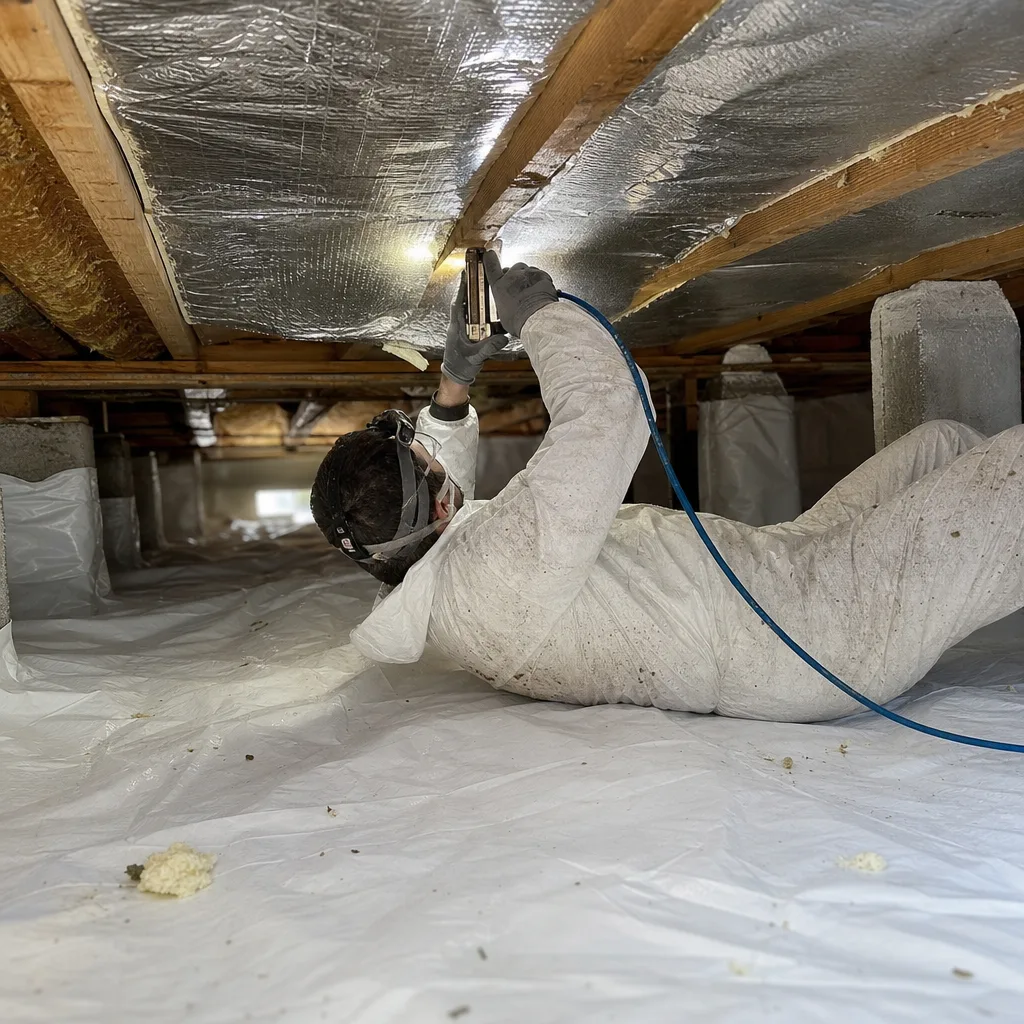
Here’s how Hayward homeowners usually find us. They climb into the attic in July and the heat hits them like a wall, or they notice the upstairs rooms are ten degrees warmer than the rest of the house even with the AC running. They look up and see the radiant barrier sagging, torn, or stapled so poorly it’s hanging in sheets. Or they bought a house where the previous owner “did it themselves” and now the barrier is doing almost nothing. The foil is still shiny in spots, but the seams are open and the whole thing is effectively decorative.
Which Owens Corning Models This Applies To
When we talk about Owens Corning radiant barrier in Hayward, we’re almost always dealing with their foil-faced attic products, most commonly the Owens Corning EcoTouch or Propink line where a low-emissivity foil face is bonded to the insulation batt, or their separate radiant barrier sheeting used on rafters and gable walls. It’s not a single “model number” product like a furnace part. It’s a building material that gets installed two ways: draped over attic floor insulation, or stapled to the underside of roof rafters.
Here’s the compatibility gotcha most people miss. The Owens Corning foil-faced batt only works as a radiant barrier if there’s at least a three-quarter inch air space in front of the foil side. Install it foil-down directly against the drywall and you’ve bought yourself a very expensive vapor retarder that does almost nothing for heat. We see this in Hayward attics all the time, especially in houses from the 1960s and 70s near B Street and up toward the hills where attic clearances are tight. The other thing: if you have the foil-faced batt already and it’s torn or compressed, you generally don’t need a full replacement. You need a separate standalone radiant barrier stapled to the rafters, which is a different material than the batt facing. We stock both types on the truck, including Reflectix as a quality aftermarket equivalent when Owens Corning sheet isn’t the right fit for the job.
Signs Your Owens Corning Radiant Barrier Installation Is Failing
- Upstairs rooms run 8 to 12 degrees hotter than downstairs on summer afternoons. The barrier has lost its air gap or the foil has oxidized to the point where it’s reflecting almost nothing. A working radiant barrier reflects 95 to 97 percent of radiant heat back toward the roof deck. A failed one reflects maybe half that.
- You can see sagging or detached sections hanging from the rafters. Staples fail in Hayward’s heat cycle. The attic hits 140 degrees, the wood expands and contracts, and cheap staples or tight stapling patterns pop loose. Once a section sags, the air gap is gone and that section stops working.
- The foil side is dusty or has a dull, gray film. Radiant barrier loses effectiveness when dust settles on the reflective surface. In Hayward, with the dry summers and the wind coming through the hills, attics collect fine dust faster than you’d expect. A layer of dust cuts reflectivity significantly, sometimes down to 30 percent.
- You find torn or shredded foil around attic vents or the access hatch. Raccoons, roof rats, and squirrels are common in Hayward neighborhoods with mature trees, especially around the Japanese Gardens and the older sections of town. They tear through radiant barrier to nest. Once it’s shredded, the only real fix is removal and replacement of those sections.
- Your energy bills climb year over year even though your usage hasn’t changed. This is the quiet symptom. A radiant barrier that’s failing gradually forces your AC to work harder, and you won’t feel it as a sudden problem. You’ll just see July and August bills creep up $40 to $80 compared to the same months a few years earlier.
Replacement Cost & What’s Included
For a radiant barrier installation in a typical Hayward attic, here’s the honest price picture:
- Standalone radiant barrier, stapled to rafters: $1.50 to $2.25 per square foot installed
- Foil-faced batt replacement (Owens Corning EcoTouch or equivalent): $2.00 to $2.75 per square foot installed
- Attic floor barrier, laid over existing insulation: $1.25 to $1.75 per square foot installed
- Removal of failed or damaged barrier: $0.50 to $0.80 per square foot
What drives the range: attic height and accessibility (crawl spaces with low clearance cost more in labor), how much old material we’re removing, and whether you’re doing the whole attic or just problem sections. Every quote includes the material, labor, cleanup, and our lifetime workmanship guarantee under the Done Right Promise. If it’s not done right, we make it right. No runaround, no “that’s normal wear.” We’ve been doing this since 2000 and we still answer the phone ourselves.
DIY or Call Us?
Radiant barrier installation isn’t electrically dangerous like wiring or high-tension like a garage door spring, but it does put you in a 130-plus degree attic, walking on joists over your own ceiling, with a staple gun. That’s where the real risk is. Every year we talk to Hayward homeowners who tried to do it themselves in August, got heat exhaustion about forty minutes in, and left the job half-finished with barrier hanging loose. Sweating through your clothes and fighting a staple gun on a ladder in an attic that feels like an oven isn’t a weekend project. It’s how you end up with a hole in your drywall and a hospital bill.
What you can safely do: go up in the early morning with a flashlight, take photos of the existing barrier, note whether it’s batt-mounted or standalone sheet, and measure your attic floor area roughly. That’s genuinely useful and helps us quote accurately over the phone. What you shouldn’t do: start tearing out old barrier, especially if you don’t know what’s under it or whether the wiring up there is old knob-and-tube. Call us at (510) 871-9022 before you start pulling anything apart. We’ll tell you straight what needs doing and what doesn’t.
FAQs
A properly installed radiant barrier in a Hayward attic lasts 15 to 20 years before it needs replacement, though dust accumulation and animal damage can shorten that significantly. The foil itself doesn’t rot, but the reflective surface degrades as dust and oxidation build up, and the staples holding it eventually fail from the heat cycle. If your barrier is older than 15 years or you’re seeing any of the failure signs above, it’s worth having us take a look. Call (510) 871-9022 and we’ll schedule a no trip charge inspection inside the county.
Yes, in many cases small sections can be repaired rather than replacing the entire barrier, especially if the damage is localized around a vent or the access hatch. If more than about 30 percent of the barrier is sagging, torn, or dust-coated, replacement is usually cheaper than chasing individual repairs. We’ll tell you which one makes sense for your attic, and we offer a free second opinion on any written estimate you’ve received.
For a standard Hayward single-story home, radiant barrier installation takes half a day to a full day depending on attic size and how much old material needs to come out first. Most jobs are done in one visit, and we’ll show you photos of the finished work before we leave.
We keep standalone radiant barrier sheet, Owens Corning foil-faced batts, and Reflectix on our trucks for most Hayward jobs, so we can usually handle same-day or next-day installation without waiting on a supply house. Give us a call at (510) 871-9022 and we’ll confirm what’s on the truck that day.
Walt’s Insulation is an independent local contractor and is not affiliated with Owens Corning. We install their products and other quality brands because they work, not because anyone tells us to.
Written by Walt Brenner, Owner, Walt’s Insulation at Walt’s Insulation, serving Hayward and nearby areas.