
Icynene Attic Insulation: The Hayward Owner’s Guide
If you have Icynene spray foam in your Hayward attic and it’s started pulling away from the roof deck, crumbling, or you’ve noticed your energy bills creeping up, we can help. Walt’s Insulation stocks Icynene-compatible open-cell and closed-cell foam, handles full attic insulation removal and replacement, and typically quotes Hayward homeowners between $2,800 and $6,400 for a standard attic re-foam depending on square footage and how much old material needs to come out first. Most Icynene jobs we can schedule within 3 to 5 business days, and we answer the phone live when you call. Here’s the thing about spray foam: when it’s installed right, it lasts decades. When it’s not, or when something goes wrong with the substrate underneath, you’ll see it fail in predictable ways we can walk you through.
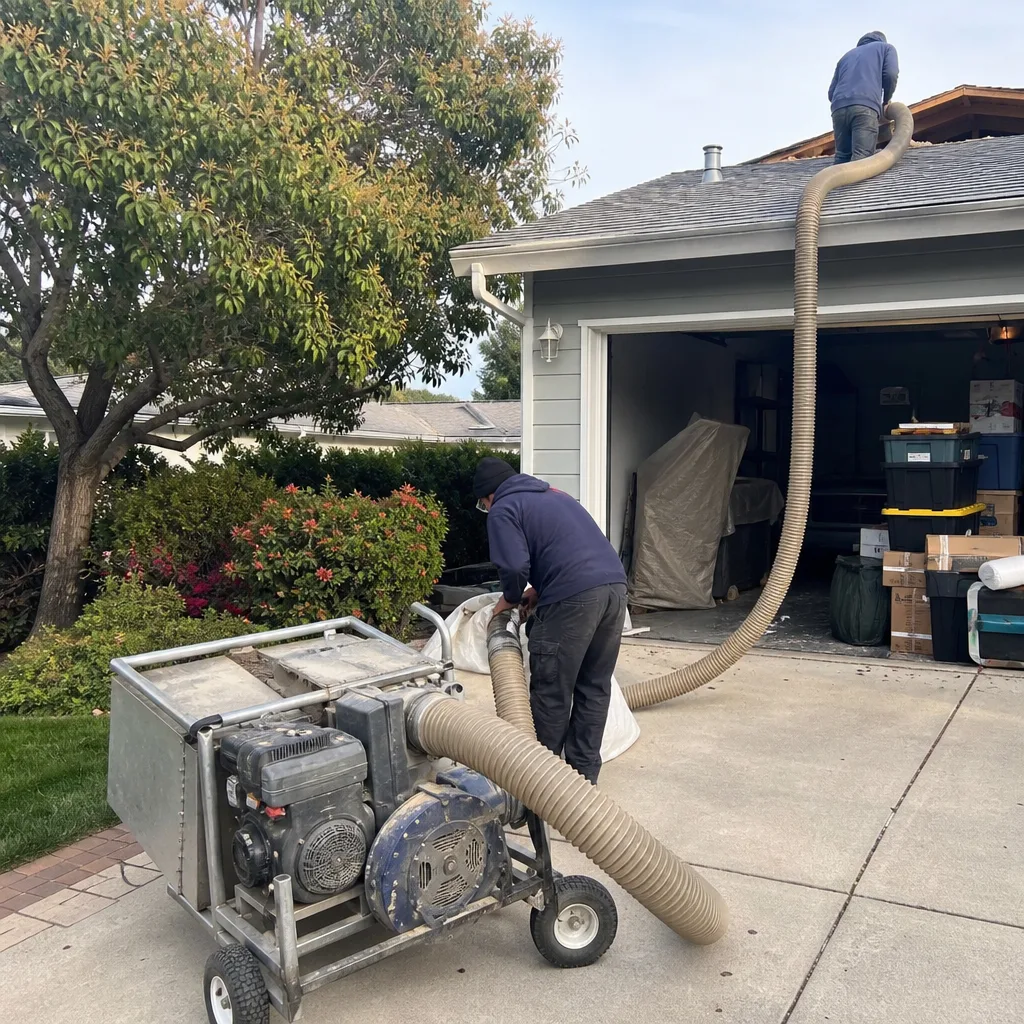
Key Takeaways:
- Icynene foam failure in Hayward is usually tied to moisture, improper mixing at install, or substrate separation
- Most homeowners discover the problem through rising PG&E bills or visible shrinkage around roof decking
- We stock Icynene-compatible foam and can match open-cell or closed-cell for your specific attic
- Full removal and re-application on a typical Hayward rancher takes 2 to 3 days
- All work carries our lifetime Done Right Promise, plus a free second opinion on any written estimate
Which Icynene Models This Applies To
Icynene has gone through several product generations since the brand hit the market, and the good news is that most Hayward homes we work on fall into one of three recognizable lines. The classic Icynene Classic and Classic Max are open-cell, water-blown foams that went into thousands of East Bay attics through the 2000s and early 2010s. The ProSeal and ProSeal LE lines are closed-cell foams with higher R-value per inch, often found in newer construction out toward the Hayward hills and in homes built after about 2015. There’s also Icynene MD-C-200, a medium-density foam that shows up in some commercial-to-residential conversions around the city.
Here’s the compatibility gotcha most homeowners don’t know: Icynene formulations are not universally cross-compatible between open-cell and closed-cell, and you can’t simply spray closed-cell over failing open-cell and expect it to bond properly. The old foam has to come out first. If you’re not sure which Icynene product is in your attic, look for the installer’s label near the attic hatch or on the roof decking itself. No label? We can identify it by density, color, and cell structure in about five minutes. As an independent Hayward contractor, we’re not affiliated with Icynene directly, but we’ve been installing and removing their products since the early 2000s and know exactly how each line behaves under California heat and marine-layer humidity.
We also stock Reflectix radiant barrier products for attics where a foil-laminate supplement makes more sense than full foam replacement, which is sometimes the smarter call in older Hayward homes with shallow roof pitches.
Signs Your Icynene Attic Insulation Is Failing
- Visible shrinkage or pull-away from roof decking. Open-cell Icynene can shrink slightly as it cures, but if you see gaps larger than a quarter inch between foam and wood, the bond has failed. We see this most in Hayward homes built with high-moisture lumber or roofs that got re-shingled too soon after the original foam job.
- Crumbling or dusting foam particles. Closed-cell Icynene should be rigid and hard. If it flakes when you touch it, the chemical reaction was off at install, usually an A-side/B-side mix imbalance. This doesn’t fix itself, and the R-value drops fast once the cell structure starts breaking down.
- A damp, musty smell that won’t go away. Improperly installed open-cell foam can trap moisture against the roof deck. In Hayward’s climate, where we get cool marine air rolling in off the bay most evenings, that moisture doesn’t dry out on its own, and it eventually leads to rot and mold on the decking itself.
- Hot upstairs rooms in summer despite having foam. If your second story bakes every July and August, the foam may have delaminated from the underside of the roof sheathing, leaving air channels that let heat pour straight into the attic. We’ve measured 20-degree differences between functioning and failed sections in the same Hayward attic.
- Higher PG&E bills with no other explanation. This is often the first clue. Air conditioning in Hayward runs hard from June through September, and a failed foam layer means your equipment works double-time. If your summer bills jumped 30% or more year over year, the attic insulation is worth checking before you look at the HVAC system.
Replacement Cost & What’s Included
For Hayward homeowners, here’s the honest breakdown. A full Icynene attic insulation removal and replacement typically runs $2,800 to $4,200 for a 1,000 to 1,400 square foot attic using open-cell foam. Closed-cell jobs run higher, usually $4,500 to $6,400, because the material costs more per board foot and removal of failed closed-cell is more labor-intensive. Smaller spot repairs, where we cut out a failed section and reapply foam to match, start around $900.
Every quote includes full removal and disposal of old foam where needed, air sealing around penetrations if we find gaps, the new foam application to the manufacturer’s spec, and a walk-through so you can see the finished work before we pack up. Our lifetime Done Right Promise covers workmanship with no fine print. We’ll also give you a free second opinion on any written estimate you’ve gotten, and $40 off any repair over $200. Seniors and veterans get 10% off, always. No trip charge inside our service county.
DIY or Call Us?
You can safely do the inspection part yourself. Go up with a flashlight and look for the signs above: gaps, crumbling, dampness, or a musty smell. You can also do a touch test on closed-cell foam, which should be hard, not spongy. What you shouldn’t do is try to cut out failing spray foam and reapply it with a DIY kit or, worse, leave failed sections in place and just spray more foam on top. Spray foam is a two-part chemical system that requires proper mixing ratios, substrate preparation, and ventilation. Get the ratio wrong and you’ll have foam that never cures, off-gasses in your living space, or holds moisture against your roof deck until the plywood rots. That repair costs far more than calling us first. If you’ve spotted a problem, call (510) 871-9022 and describe what you see. We’ll tell you over the phone whether it sounds urgent or can wait, and we’ll schedule a look for free if you’re in our service county.
FAQs
Properly installed Icynene foam lasts 30 years or more, even in Hayward’s marine climate. The failures we see are almost always install-related, not age-related. Closed-cell and open-cell both hold up well to East Bay weather when the mix ratio was right and the roof deck was dry at application.
Sometimes, yes. If the failure is localized, like a single bay between rafters or a section around a vent penetration, we can cut out the bad foam and reapply to match without touching the rest of the attic. If the foam is failing across multiple areas, full removal and replacement is usually cheaper long-term and gives you a clean warranty on the whole attic. Call (510) 871-9022 and we’ll tell you which path makes sense for your situation.
Most full removal and replacement jobs take 2 to 3 days. Day one is removal and prep, which includes grinding out old foam and addressing any moisture issues on the decking. Day two or three is application and cure time, after which you can go back into the attic the same afternoon. Spot repairs are usually done in a single visit.
We keep open-cell and closed-cell Icynene-compatible foam on hand for most Hayward jobs, including the densities needed to match Classic, ProSeal, and MD-C-200 applications. If your attic has an unusual foam depth or we’re matching an old industrial spec, we may need a day or two to bring in the right product. We also stock Reflectix radiant barrier for supplemental attic work. Call us and we’ll confirm what we can bring the same week.
If your Icynene attic insulation is failing or you just want a straight answer on whether it’s still doing its job, call Walt’s Insulation at (510) 871-9022. We answer the phone live because your attic doesn’t keep business hours. Free estimates, no trip charge in our service county, and a lifetime guarantee on everything we install. We’re the one down the road in Hayward, not an 800 number in another state.
Written by Walt Brenner, Owner, Walt’s Insulation at Walt’s Insulation, serving Hayward and nearby areas.