
GreenFiber Attic Insulation: The Hayward Owner’s Guide
GreenFiber attic insulation in Hayward typically costs $1.40 to $2.80 per square foot installed, and yes, we keep it on our trucks and can usually get it blown in same-day. Most Hayward homeowners don’t discover their GreenFiber has failed until they notice an upstairs room that won’t hold temperature or a utility bill that spiked for no obvious reason. What you’re dealing with is almost always one of three things: settled insulation that’s lost its loft, moisture-compromised material from a roof leak or bathroom vent dumping into the attic, or gaps where the original install missed a section entirely. We’re an independent Hayward insulation company, not affiliated with GreenFiber the manufacturer, but we’ve been installing and repairing their product line for years.
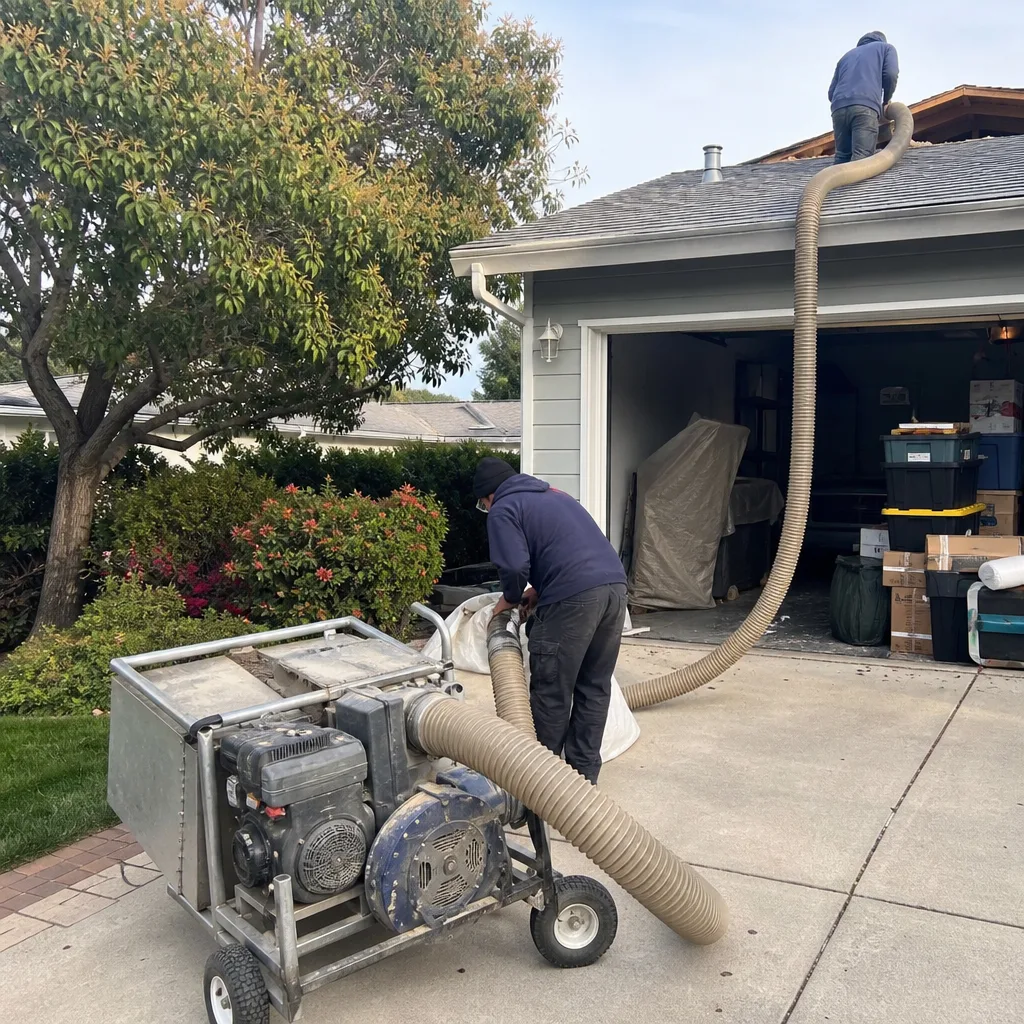
The good news is that GreenFiber is a blown-in cellulose product, which means it’s forgiving to work with and relatively straightforward to correct. The bad news is that once it’s wet, settled, or displaced, it doesn’t recover on its own. You can’t fluff it back up. It has to come out or be topped off with fresh material. Here’s what you need to know before you spend a dollar.
Which GreenFiber Models This Applies To
GreenFiber sells its blown-in attic insulation primarily under the SANCTUARY and Insulation Plus product lines, plus a low-dust variant called INS550LD that became common in California installs over the last decade. The material itself is the same basic formulation across lines: about 85% recycled paper fiber treated with boric acid for fire and pest resistance. The differences are in the bag weight, the fluff ratio (how many square feet you get per bag at a target R-value), and whether the product is labeled for machine-only application or hand-pour in tight attic corners.
The compatibility gotcha most Hayward homeowners run into: you cannot just buy any cellulose and blow it over an existing layer and call it matched. GreenFiber’s per-bag coverage assumes a specific settled density, and if you top off with a lighter or denser cellulose from another brand, your final R-value won’t be what the bag math says. We’ve measured attics in the Burbank neighborhood where a previous contractor topped off GreenFiber with a bargain-basement cellulose, and the settled result was R-30 where the paperwork claimed R-38. That’s not a paperwork problem, it’s a heating bill problem. If you’re adding to existing GreenFiber, you want GreenFiber going back on top, or a cellulose with a matching densification spec. We also keep Reflectix and other brands on the truck, but for a GreenFiber top-off, we match GreenFiber.
How to confirm what you have before you call: look for the product code printed on the bag edges if you have partial bags stored in the garage, or check the attic card left by the original installer. If neither exists, we can identify it by settled density and fiber color in about five minutes during a free estimate visit.
Signs Your GreenFiber Attic Insulation Is Failing
- Upstairs rooms run 8 to 12 degrees warmer than the thermostat in summer. This usually means the GreenFiber has settled below the top of the ceiling joists in spots, leaving bare patches where heat pours straight through. Cellulose settles 5-10% in the first year, and a bad initial blow can settle far more.
- Vaulted or sloped ceiling sections feel hot to the touch by midafternoon. GreenFiber doesn’t slide down slopes on its own, but if it was blown too shallow at the eaves, or if it’s been walked on during HVAC work, those slopes end up thin. Direct sun on Hayward roofs in August turns a thin spot into a heat register pointed at your hallway.
- You find small piles of gray-brown fuzz below recessed light trims or bath fan housings. This is a sign the material is getting disturbed, often by attic airflow, or that a rodent has been tunneling through it. Either way, the insulation is no longer where it’s supposed to be.
- Your heating bill this winter was 30% higher than the same months last year without a rate change. Settled or displaced GreenFiber quietly drops your effective R-value. R-38 can behave like R-19 when the blanket is uneven, and your furnace runs longer to compensate.
- You see darkened, matted-down areas (or a musty smell) when you peek through the attic hatch. That’s moisture. Wet GreenFiber loses nearly all its insulative value and never dries back to its original loft. It also becomes a mold host if left alone. Hayward’s fog-damp winters make roof-leak and condensation issues show up as this exact symptom.
Replacement Cost & What’s Included
For a typical 1,200 to 1,500 square foot Hayward attic, a full GreenFiber removal and re-blow to R-38 runs between $2,400 and $3,700, depending on attic height, access, and how much old material has to come out first. If your existing GreenFiber is dry and just under-filled, a top-off to bring it back to code is far cheaper, usually $900 to $1,600 for the same attic size.
What drives the spreads: whether your attic has a standard pulldown hatch or a tight scuttle hole, whether we’re working around stored Christmas decorations and wiring, and whether the old material is contaminated with rodent droppings (Hayward has plenty of squirrels and roof rats, and we deal with both). Every quote includes removal labor, disposal, new GreenFiber material, machine time, and cleanup.
Our work is covered by the Done Right Promise: if it’s not done right, we make it right. No runaround, no re-quote dance. That’s a lifetime workmanship guarantee on top of the manufacturer’s material spec.
DIY or Call Us?
Here’s the honest split. You can safely open your attic hatch, shine a flashlight around, and check whether the GreenFiber is level or if there are bare bays and thin slopes. You can also check for roof staining above the insulation and feel whether the material is fluffy or matted. That’s worth doing, and it helps you talk to any contractor with more confidence.
Where DIY goes wrong: blowing cellulose yourself means renting a machine, buying the right GreenFiber bags (not whatever insulation the rental counter hands you), and achieving consistent density without over-fluffing. Most first-timers blow too shallow at the eaves and overstuff the center, which creates exactly the uneven performance you’re trying to fix. And if your GreenFiber is wet or rodent-soiled, bag removal is dusty, heavy, and unpleasant even with a respirator and Tyvek. For a top-off on a dry attic, a motivated Hayward homeowner with a rented blower can do the job. But if the material is wet, contaminated, or you’re chasing an R-value upgrade, you want a crew that does this every week. Call us at (510) 871-9022 and we’ll tell you straight which situation you have, no pressure.
FAQs
GreenFiber cellulose lasts 20 to 30 years when the attic stays dry, which is why we check for moisture first on every Hayward visit. The material doesn’t break down on its own, but roof leaks, condensation, and rodents can ruin sections long before that mark.
Yes, if the problem is localized (one slope, one bay, one corner), we can remove and re-blow just that section, which is the most cost-effective fix for small failures. The key is matching the GreenFiber product spec so the repaired area blends with the surrounding R-value. Call (510) 871-9022 for an exact quote.
A full removal and re-blow for a standard Hayward attic takes one day, usually five to seven hours including setup and cleanup. A top-off takes two to three hours. We haul the old material away the same day.
We do, in the common SANCTUARY and Insulation Plus bag specs, which is why we can usually get Hayward jobs done same-day or within 24 hours. If your attic needs the low-dust INS550LD variant, we’ll source it within one to two days and keep you informed. Estimates are always free, and we offer a free second opinion on any written estimate you already have.
Written by Walt Brenner, Owner, Walt’s Insulation at Walt’s Insulation, serving Hayward and nearby areas.