
Demilec Crawl Space Encapsulation: The Hayward Owner’s Guide
If you have a Demilec spray foam crawl space encapsulation that’s peeling, cracking, or pulling away from your foundation walls, we can match it, source the right replacement, and get it fixed, usually within a few days. For most Hayward homes, repairing a failed Demilec encapsulation runs between $1,800 and $4,200 depending on square footage and how far the foam has degraded. We stock Demilec Heatlok HFO and Sealection 500 on our trucks, so if it’s a straightforward patch and re-seal, we can often handle it same-day.
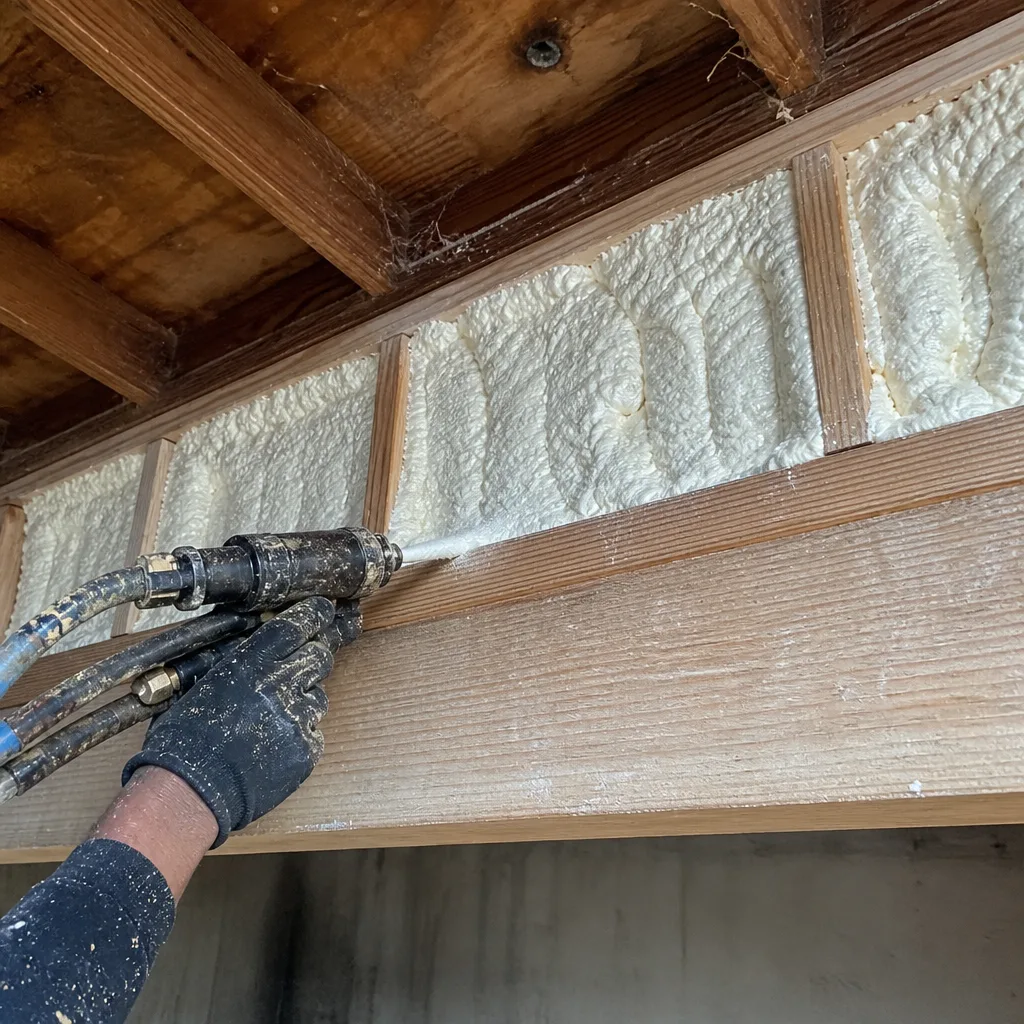
Most homeowners discover their Demilec encapsulation has failed the same way: a musty smell that won’t go away, higher humidity in the house, or a floor that feels damp even in August. Sometimes it’s a pest problem, because rodents will tunnel right through compromised foam. By the time you notice it, the foam has usually been failing for a while. That’s normal. Crawl spaces in Hayward deal with fog, marine air, and clay soil that holds water, and even the best closed-cell foam eventually breaks down under those conditions.
Which Demilec Models This Applies To
Demilec makes two product lines we regularly work with in Hayward crawl spaces: Heatlok HFO and Sealection 500. Heatlok HFO is a closed-cell foam, typically applied at 2 inches for crawl space walls and rim joists, and it’s the product most homeowners have when the encapsulation is also acting as the air barrier and vapor barrier. Sealection 500 is an open-cell, half-pound foam that’s used more often when the crawl space is being insulated for sound or when the budget is tighter. Knowing which one you have matters, because you can’t patch open-cell with closed-cell and expect it to hold.
If you’re not sure what’s in your crawl space, look for a white or cream-colored label stapled near the access door, or check your original contract. Demilec installers are supposed to leave documentation, but plenty don’t. If there’s no label, we can identify it in about five minutes by looking at the foam texture and density. One compatibility gotcha to know: Heatlok HFO is not a suitable patch over older Heatlok Soy or Heatlok XT installations without mechanical removal of the old foam first. The chemistry doesn’t bond correctly, and it’ll peel within a year. We’ve fixed enough of those in Hayward ranch homes to know it’s a waste of money to skip the removal step.
Signs Your Demilec Crawl Space Encapsulation Is Failing
- Persistent musty or earthy smell upstairs. This is usually the first sign. When closed-cell foam pulls away from the foundation wall, moisture gets between the foam and the concrete, and that damp, organic smell rises up through the floor assembly.
- Foam that’s shrinking, cracking, or pulling away from the sill plate. Demilec foam expands and contracts with temperature swings. In Hayward, the crawl space can drop into the 40s in January and hit the 80s by September, and that cycling stresses the bond line. Once you see gaps at the top edge near the rim joist, the seal is already broken.
- Condensation on ductwork or pipes in the crawl space. Your encapsulation is supposed to keep the crawl space dry enough that metal surfaces don’t sweat. If you’re seeing beads of water on your HVAC ducts, the vapor barrier function has failed somewhere, even if the foam looks intact from a distance.
- Rodent activity or tunneling in the foam. Rats and mice don’t usually eat closed-cell foam, but they’ll tunnel through it if it’s already compromised. In Hayward, roof rats are a year-round issue, and a weak spot in your Demilec foam is an open invitation.
- Higher summer humidity in the house or a spike in cooling bills. When the encapsulation fails, moist air from the soil moves up through the house. Your AC has to work harder to pull that moisture out, and you’ll feel it as a heavier, stickier indoor air quality, especially in August.
Replacement Cost & What’s Included
In Hayward, a full Demilec crawl space encapsulation replacement on a typical 1,200 to 1,600 square foot ranch runs $3,000 to $4,200 installed. That includes removing the failed foam where necessary, prepping the surface, re-foaming the walls and rim joist, and sealing all penetrations. A targeted repair, where we cut out the bad section and patch it, usually runs $1,800 to $2,600 depending on accessibility and how much foam has to come out.
What drives the price is access. If your crawl space has 18 inches of clearance and a dirt floor, it’s slow, difficult work. If you have a 3-foot clearance with a gravel floor, it’s easier and costs less. We give you one price before we start, and it includes parts, labor, and haul-away of any removed foam. Everything we install is backed by our lifetime Done Right Promise. If it’s not done right, we make it right, no runaround, no charge. That’s how Walt’s Insulation has operated since 2000, and it’s not changing.
DIY or Call Us?
You can safely inspect your own crawl space if you wear long sleeves, gloves, and a respirator rated for particulates. Look for the signs above, take photos with your phone, and measure roughly how many feet of wall and rim joist are affected. That information helps us give you an accurate ballpark over the phone.
What you shouldn’t do is try to patch Demilec foam yourself. The two-part spray foam kits sold at home centers are not the same chemistry as Demilec products, and they won’t bond correctly to the existing foam. Worse, spraying in a confined crawl space without proper ventilation and a full-face respirator is genuinely dangerous. The isocyanates in uncured spray foam can cause serious respiratory damage. We have the right equipment, the right foam, and the training to do it safely. Walt Brenner has been doing this since 2000, and our techs are background-checked and uniformed on every job, so you know exactly who’s under your house. Call (510) 871-9022 and we’ll get eyes on it, usually within a day or two.
FAQs
In Hayward’s climate, a properly installed Demilec Heatlok HFO encapsulation should last 20 to 25 years. Sealection 500 typically lasts 15 to 20 years. Failures before that are almost always installation-related: insufficient surface prep, spraying over moisture, or not hitting the right foam thickness.
It depends on how far the failure has spread. If more than 30% of the foam has pulled away from the wall, replacement is usually cheaper in the long run than chasing patches. A small section of failed foam can be cut out and re-sprayed cleanly. Call (510) 871-9022 with your symptoms and we’ll tell you honestly which path makes sense.
Most Hayward crawl spaces take one full day for removal and re-foaming, plus a few hours the following morning for final inspection and air quality checks. Larger homes or crawl spaces with poor access can run two days. We’ll give you a clear timeline when we quote the job.
We keep Heatlok HFO and Sealection 500 on our trucks, along with the Demilec-compatible accessories needed for a proper seal. We also stock Reflectix for radiant barrier applications if your crawl space needs that as well. In most cases, we can start the repair the day we diagnose it.
Written by Walt Brenner, Owner, Walt’s Insulation at Walt’s Insulation, serving Hayward and nearby areas.