
CertainTeed Radiant Barrier Installation: The Hayward Owner’s Guide
CertainTeed radiant barrier installation in Hayward typically runs $1.40 to $2.60 per square foot installed, with most single-story homes landing between $1,800 and $3,400 total. We stock CertainTeed-compatible radiant barrier on our trucks and can usually be on-site the same day you call. The part most Hayward homeowners call us about isn’t a failed panel, it’s the detection that their barrier was never installed correctly in the first place: gaps at the seams, sagging sheets, or the wrong side facing the attic air space.
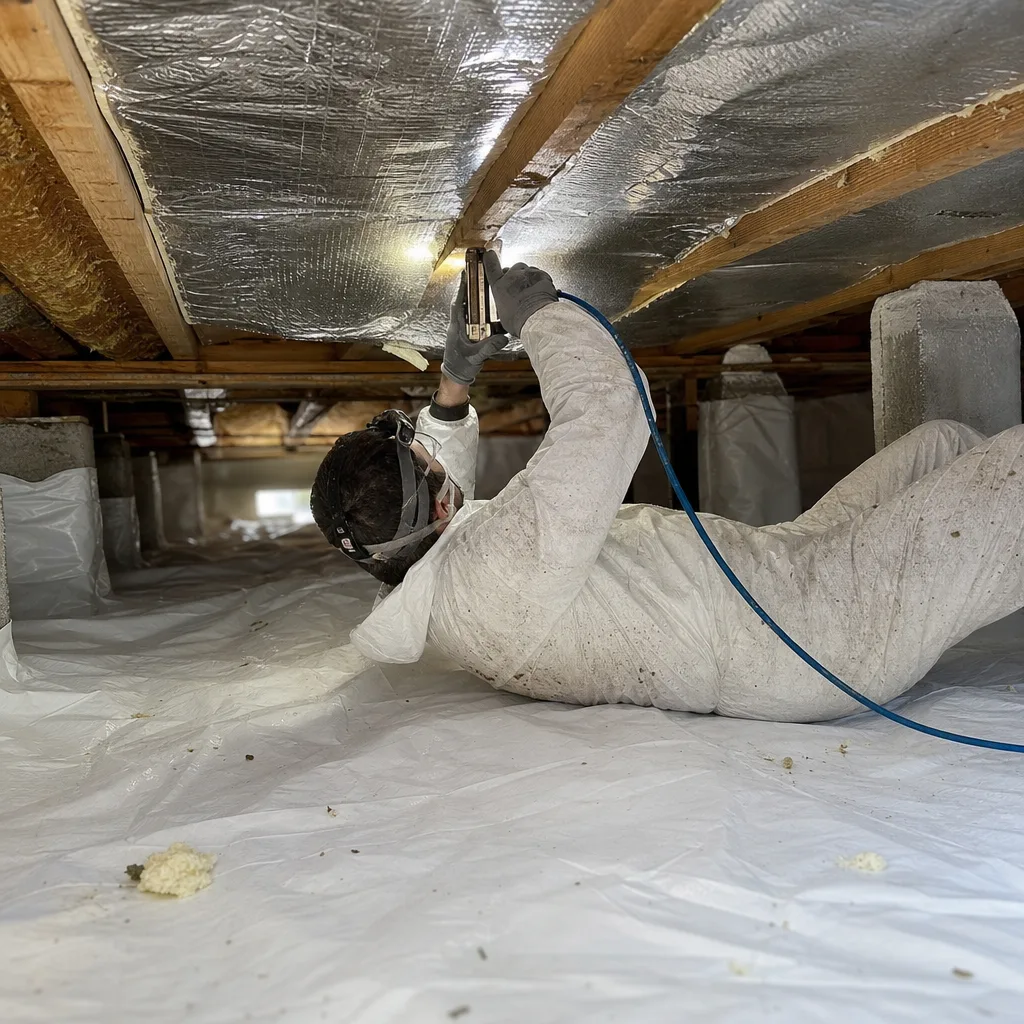
Here’s the reality we see every week across Hayward. Radiant barrier works by reflecting heat, not absorbing it. When the shiny side faces the wrong way or the sheets get stapled flat against the roof deck with no air gap, they stop doing their job. You don’t notice until August, when the upstairs bedrooms hit 85 degrees and your AC hasn’t shut off since noon. That’s the call we get. And it’s almost always fixable.
Which CertainTeed Models This Applies To
CertainTeed sells radiant barrier under two main lines: EnerWrap and MemBrain. EnerWrap is the dedicated radiant barrier product, a perforated aluminum foil bonded to a kraft paper or polypropylene backing. MemBrain is more of a smart vapor retarder that some homeowners use in combination with radiant barrier, but it is not a true radiant barrier on its own. We’ve seen people buy MemBrain thinking they were getting a reflective product, and that’s a compatibility gotcha worth knowing: if you want heat reflection in a Hayward attic, you need EnerWrap or an equivalent, not MemBrain.
For identification, look at the roll edge. EnerWrap prints the product name, the perforation pattern, and the ASTM C1313 compliance marking every few feet along the roll. If you can’t find the label, measure the foil: EnerWrap comes in 26-inch and 48-inch widths, with the 48-inch being the one we install 90% of the time in Hayward because it spans standard 24-inch rafter bays with fewer seams. Aftermarket equivalents from Reflectix work fine in most applications, but they have a different perforation density. If you’re mixing a repair section into an existing EnerWrap install, the mismatch in breathability can trap condensation where the two products meet. We stock OEM CertainTeed EnerWrap for exactly that reason.
Signs Your CertainTeed Radiant Barrier Installation Is Failing
- Upstairs rooms are 10 to 15 degrees hotter than the downstairs in summer. This almost always means the barrier has lost contact with the rafter bays, either from sagging staples or from sheets that were never pulled taught during install. Heat radiates straight through the gap.
- Visible drooping or puddling between rafters. Hayward’s marine layer puts serious humidity into attics from June through September. Kraft-paper-backed radiant barrier absorbs that moisture, loses rigidity, and sags. Once it sags, the reflective surface no longer points at the attic air space.
- Foil delaminating from the backing in sheets or flakes. We see this most in older Hayward homes near the bay side of town, where salt air accelerates the adhesive breakdown. The foil separates, curls, and becomes useless.
- Dust or grime caked on the reflective side. Radiant barrier works on reflectivity. A fine layer of dust cuts performance by up to 30%. If your barrier has been exposed for years, especially after a roof repair or rodent activity, that reflective surface is compromised.
- AC runs constantly but the house never reaches the setpoint. This is the end-stage symptom. Your insulation is fighting a losing battle because the radiant barrier above it isn’t rejecting solar gain. The fix is a proper reinstall, not another service call on the AC unit.
Replacement Cost & What’s Included
For Hayward homes, a complete CertainTeed radiant barrier installation runs between $1.40 and $2.60 per square foot, installed. That includes the CertainTeed EnerWrap material, all staples and seam tape, removal of the old failed barrier, and our labor. A 1,500-square-foot attic typically lands around $2,100 to $3,900. The range depends on three things: attic accessibility (low-pitch roofs and tight cavities slow us down), whether the old barrier needs removal, and whether you have blown-in insulation we have to work around.
What drives the cost up in Hayward specifically is the same thing that drives everything here: the older housing stock. Homes near downtown and the flats, built in the 1950s and 60s, often have cramped attics with original framing that’s uneven. Every rafter bay is a slightly different width, which means cutting each sheet to fit rather than running from a roll. Newer construction in the Hayward hills installs faster because the framing is uniform. We quote the job up front, by the square foot of attic floor, not by the hour. You know the number before we start. Every install is covered by our Done Right Promise for the lifetime of the work. If it’s not done right, we make it right, no runaround. And if you have a written estimate from anyone else, bring it to us. We’ll give you a free second opinion and $40 off any repair over $200.
DIY or Call Us?
You can absolutely check the condition of your own radiant barrier from the attic access. Look for sagging, detached staples, dust, and delamination. If you see the foil face pointing down toward the attic floor, that’s a wrong-side install and it’s been failing quietly since day one. Those checks take ten minutes and cost you nothing.
Where DIY goes sideways is the install itself. Attics in Hayward summers hit 130 degrees by late morning. Working on your knees across joists, pulling sheet material taught while handling a staple gun, is not the time to learn. Falls through ceilings send people to the emergency room every year, and an improper air gap means the barrier never works and you’ve spent a weekend for nothing. Walt Brenner’s crew has been in Hayward attics since 2000, and we still sweat through every install. If you’re not sure, call (510) 871-9022. We’ll tell you honestly whether it’s worth your time or ours.
FAQs
In a properly installed Hayward attic, CertainTeed EnerWrap lasts 15 to 20 years. The reflective foil itself doesn’t degrade much; what fails first is the adhesive layer and the kraft backing when exposed to years of marine-layer humidity. Homes on the Hayward side of the hills, where the fog sits longest, may see degradation at the lower end of that range. If your barrier is more than 15 years old and showing signs of delamination or sag, it’s time. Call (510) 871-9022 and we’ll give you an honest assessment.
Yes, in most cases. If the damage is limited to one or two rafter bays, a few sagging sheets, or a section affected by a roof leak, we can cut out the failed section and install matching CertainTeed EnerWrap in its place. The key is matching the product, because mixing brands can create condensation issues at the seams. We stock CertainTeed on the truck, so repairs usually happen the same day. If more than a third of the attic is compromised, full replacement is the better value. Call (510) 871-9022 for an honest recommendation, not an upsell.
Most Hayward homes take one full day, roughly 4 to 8 hours depending on attic size and accessibility. Low-pitch roofs, old insulation, or heavy dust can push a bigger job into a second day. We’ll tell you the timeline before we start, and it doesn’t change unless the attic surprises all of us. If you need it done around a work schedule, we’ll work with you on timing.
We stock CertainTeed EnerWrap on our trucks in the 48-inch width, which covers most Hayward homes. If your home needs the 26-inch width for odd bay spacing, we can get it from our supplier within a day or two. We also stock Reflectix as an aftermarket option. We are an independent installer, not affiliated with CertainTeed, but we’ve been installing their products since Walt Brenner started this business in 2000. The one down the road stocks what you need, because that’s the point of being local.
Written by Walt Brenner, Owner, Walt’s Insulation at Walt’s Insulation, serving Hayward and nearby areas.